
You’re keen to get back to work.
But there’s a difference between feeling better at home and getting through a full shift on the tools.
Maybe you’re a tradie, warehouse worker, nurse or someone whose job involves lifting, carrying, bending or spending hours on your feet.
After an injury, it’s reasonable to wonder whether your body is ready for all that again.
Returning to physical work isn’t just about whether your pain has improved. It’s about matching your current capacity to the demands of your job.
Here’s what that means.
1. Can you manage the physical demands of your job?
Think about what an average workday actually involves.
Are you lifting heavy equipment? Carrying materials? Repeatedly bending or reaching overhead?
Now think about how often you do those tasks.
Lifting something once in the gym is different from handling materials throughout an eight-hour shift.
That’s why returning to physical work needs to consider more than one movement.
At Coastline, we look at what your job requires and what you’re currently capable of doing.
The aim is to identify what you can manage now and what you may need to build towards.
2. Does being pain-free mean you’re ready?
Not necessarily.
Pain is one part of the picture, but it doesn’t tell us everything about your strength, endurance or ability to manage repeated tasks.
You might feel comfortable walking around the house but still find carrying equipment or standing for long periods challenging.
On the other hand, some discomfort doesn’t automatically mean you’re causing further damage.
The important thing is understanding your injury, current capacity and how you’re responding to activity.
Rather than guessing, we can use movement assessments and strength testing to help guide your exercise programme.
The goal isn’t simply to feel better. It’s to build the capacity you need for your work.
3. How can strength training help you prepare?
Strength training can be part of preparing for the demands of a physical job.
Depending on your role, your programme might include:
Squats and step-ups for lifting and climbing
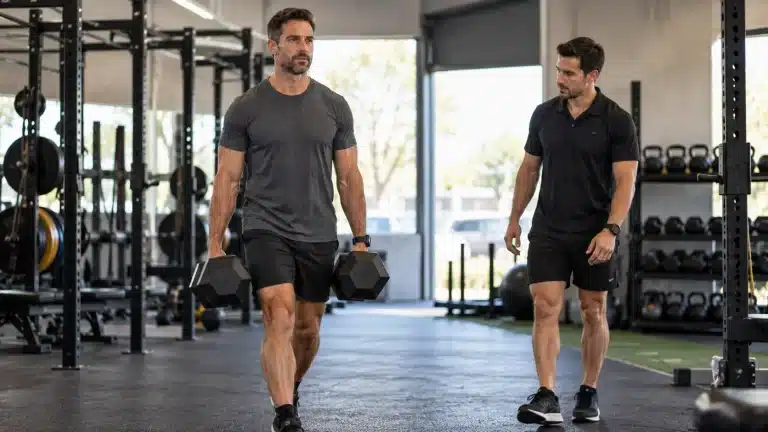
Carries for handling tools or materials
Rows and presses for pushing and pulling
Progressive lifting exercises for manual tasks
These aren’t exercises everyone needs to complete.
The right programme depends on your injury, job requirements and current ability.
At Coastline, we use a strength-first approach, progressing exercises as your capacity develops.
We want your training to have a purpose beyond the gym.
4. Do you need to return to full duties straight away?
No. A gradual return may be appropriate.
In NSW, returning to work can involve modified duties, different hours or adjusted tasks that match your current certified work capacity.
Your treating doctor, employer and insurer may be involved in planning this process.
An Exercise Physiologist can contribute by helping you develop physical capacity and sharing relevant progress information with your treating team, where appropriate.
For example, you might begin with lighter duties while progressively working towards more demanding tasks.
It’s about having a clear plan rather than jumping straight from rehabilitation to a full workload.
How Coastline helps with work injury rehabilitation
At Coastline Performance and Health in Glendale, we work with people across Newcastle and Lake Macquarie who want to get back to work and everyday life after injury.
We listen to what happened, understand what your job involves and assess your current physical capacity.
From there, we build an individualised exercise programme.
Where useful, we use VALD strength and movement testing to help measure progress.
We also work alongside your treating team when needed.
Because getting back to work should involve a plan that reflects your actual job, not just a generic list of exercises.
Frequently Asked Questions
Can I return to work while still recovering?
Sometimes, yes. Suitable duties and adjusted hours may allow you to recover while working, depending on your injury, certified capacity and workplace arrangements.
Can an Exercise Physiologist help with WorkCover rehabilitation?
Yes. An Accredited Exercise Physiologist can provide exercise-based rehabilitation, assess physical capacity and support progression towards work-related goals. WorkCover funding and treatment approval depend on your individual circumstances.
How do I know when I can return to full duties?
This should be considered with your treating doctor and return-to-work team, taking account of your current capacity, job demands and recovery progress.
Ready to build your way back to work?
Whether you're returning to the tools, the warehouse or another physically demanding job, Coastline can help you work towards the strength and capacity your role requires.
Book an appointment at CoastlineUseful Resources
SIRA NSW – Recovery After a Workplace Injury
Information about recovery through work, suitable duties and employer responsibilities.
SIRA NSW – Recover at Work Planning Tool
Practical guidance for planning duties around a worker’s current capacity.
SIRA NSW – Recovery Through Work for Workers
Guidance for injured workers on planning and participating in their return to work.
This article provides general information and does not replace individual medical advice or a formal work capacity assessment.

Contact US
Helping you rebuild strength across Lake Macquarie, Newcastle, & Port Stephens.
- 2/545 Main Rd, Glendale NSW 2285, Australia
- 02 7226 9384
- 2 Technology Pl, Williamtown NSW 2318, Australia
- +61 2 4989 5151