
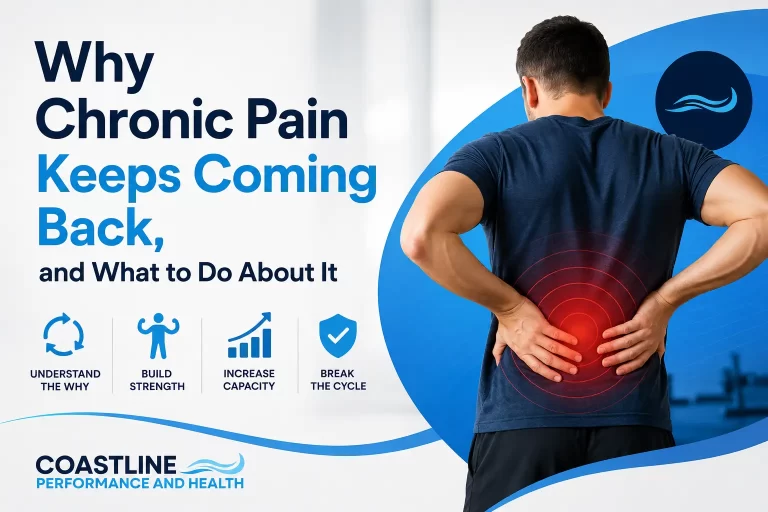
You’ve rested then tried physio. You’ve taken the medication, done the stretches, and waited it out. And for a while, it felt like things were improving.
Then it came back.
If that cycle sounds familiar, you’re not alone. And more importantly, it’s not your fault. At Coastline Performance and Health, we work with people across Lake Macquarie, Newcastle, and Port Stephens who are stuck in exactly this pattern. The good news is, there’s a reason it keeps happening, and once you understand it, you can actually do something about it.
Why the pain keeps returning
Most short-term treatments focus on reducing symptoms. Rest, medication, passive therapy, ice and heat. These things can help you feel better in the moment, but they don’t always change the underlying picture.
Chronic pain, which is pain lasting longer than three months, is different from the sharp pain you feel when you first injure yourself. Over time, your nervous system adapts. It becomes more sensitive. It starts sending pain signals more easily, sometimes even when there’s no new tissue damage at all.
This is called central sensitisation, and it means your body has essentially learned to be in pain.
Some common reasons the cycle continues:
The original cause was never fully addressed, just masked
Movement was avoided for too long, weakening the structures around the injury
Stress, poor sleep, or low mood are amplifying the pain signals
There was no structured plan to rebuild capacity after the acute phase
You were told to rest, but never told when or how to start moving again
None of these mean you’re weak or doing something wrong. They mean you needed a different kind of support.
None of these mean you’re weak or doing something wrong. They mean you needed a different kind of support.
What breaking the cycle actually looks like
For most of our clients across Lake Macquarie and Newcastle, the turning point comes when they shift from managing flare-ups to building capacity between them.
That means:
Gradual, structured strength work tailored to your body and your history
Education about what your pain signals actually mean, so movement feels less scary
Sleep, stress, and lifestyle strategies that support recovery, not just exercise alone
Clear progress markers so you can see how far you’ve come, even on harder days
A plan that adjusts when pain shows up, rather than stopping everything
It’s not a quick fix. But it’s a real one.
When to stop waiting and start building
A lot of people come to us after months or years of the same cycle. They’ve been waiting for the pain to fully settle before they start doing something about it.
The problem is, for chronic pain, that moment rarely comes on its own.
The research is clear that graded exercise and movement-based rehabilitation, guided by a qualified exercise physiologist, is one of the most effective approaches for long-term chronic pain management. Not because it ignores the pain, but because it changes the conditions that keep producing it.
If you’ve been living in that cycle of flare-up, rest, brief improvement, and repeat, that’s a signal your body needs a different approach, not more of the same.
Break the cycle with a plan that actually works
Chronic pain that keeps coming back is telling you something. Not that you’re broken, but that the approach needs to change.
At Coastline Performance and Health, we help people across Lake Macquarie, Newcastle, Glendale, Port Stephens, and Williamtown build real, lasting capacity through evidence-based exercise physiology and strength coaching.
👉 Book a consultation today and let’s build a plan that stops the cycle for good.
Frequently Asked Questions
Why does my chronic pain keep flaring up even when I rest?
Rest reduces symptoms short-term but doesn't address the underlying sensitivity in your nervous system or the physical capacity gaps that make flare-ups more likely. A structured rehabilitation program helps retrain both.
Is it safe to exercise when I'm in chronic pain?
Yes, when it's guided correctly. Graded exercise prescribed by an accredited exercise physiologist is one of the most evidence-supported approaches for chronic pain. The key is starting at the right level for your body and progressing gradually.
How is an exercise physiologist different from a physio for chronic pain?
Both play valuable roles. An exercise physiologist specialises in long-term, movement-based rehabilitation, building your physical capacity over time rather than focusing on acute injury treatment. For chronic pain, this ongoing capacity-building approach is often what makes the biggest difference.
How long before I see a difference?
Progress looks different for everyone. What we can tell you is that we track it with real data at every stage, so you'll always know where you stand and what's changing, even when it feels slow.








Contact US
Helping you rebuild strength across Lake Macquarie, Newcastle, & Port Stephens.
- 2/545 Main Rd, Glendale NSW 2285, Australia
- 02 7226 9384
- 2 Technology Pl, Williamtown NSW 2318, Australia
- +61 2 4989 5151