
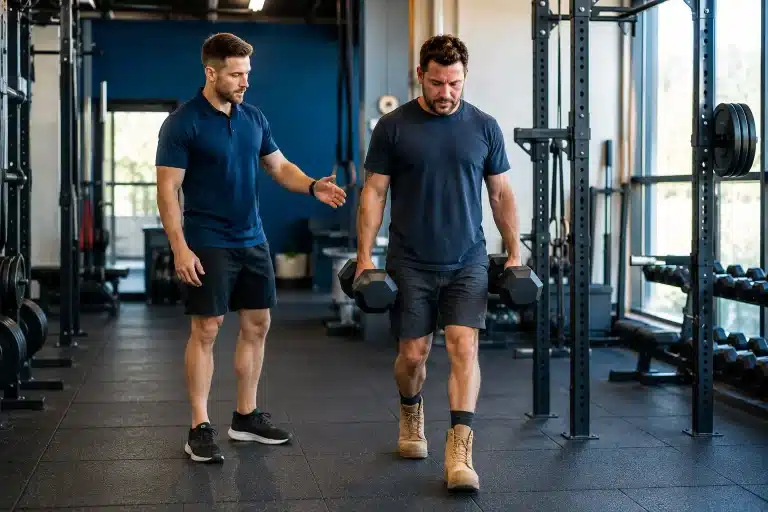
Returning to work after an injury can involve more than feeling comfortable during a few exercises.
Work has physical demands.
A builder may need to lift materials from the ground.
A nurse may spend hours standing, walking and assisting patients.
A warehouse worker might repeatedly lift, carry, push and pull.
So when exercise forms part of workplace rehabilitation, it should have a purpose.
A WorkCover Exercise Physiologist uses structured exercise to help build physical capacity towards the demands of work.
That means looking beyond the injury itself and asking an important question:
What does this person’s body actually need to do at work?
What Is WorkCover Exercise Physiology?
WorkCover Exercise Physiology uses exercise and physical conditioning as part of workplace injury rehabilitation.
An Accredited Exercise Physiologist can assess a person’s current physical capacity and develop an exercise program around relevant rehabilitation and work goals.
Depending on the person and their job, this may involve working on:
Lifting capacity
Carrying capacity
Pushing and pulling
Lower-body strength
Upper-body strength
Work tolerance
Repeated movements
General physical conditioning
The program should reflect the individual rather than giving every worker the same exercises.
Why Does Work Capacity Matter?
Imagine someone can comfortably lift 5 kg in a clinic.
That’s useful information.
But what if their job regularly requires them to handle much heavier equipment?
Or what if they can lift something once, but their normal shift requires similar movements repeatedly throughout the day?
There can be a gap between being able to perform an exercise and being physically prepared for work.
A return-to-work exercise program can progressively work on that gap.
Instead of asking only:
“Can you do this exercise?”
We can also ask:
“How does this relate to what your job requires?”
That changes how rehabilitation is planned.
What Does a WorkCover Exercise Physiologist Assess?
An assessment will vary depending on the worker, injury, current capacity and job.
The Exercise Physiologist may discuss:
Your work tasks
What does a normal workday actually involve?
This could include lifting, carrying, climbing, kneeling, reaching, walking or operating equipment.
Current physical capacity
The Exercise Physiologist may assess relevant movements and physical qualities to better understand the worker’s starting point.
Current exercise tolerance
How much activity can currently be completed?
How does the person respond to different exercises and workloads?
Rehabilitation goals
Returning to work is not always one big jump from “off work” to “full duties”.
There may be smaller capacity goals along the way.
Understanding those goals helps shape the exercise program.
WorkCover Exercise Physiology Isn’t Just General Gym Training
Two people can perform the same squat and need it for completely different reasons.
For one person, squatting might support general strength.
For a tradie, it could be part of developing the leg and trunk capacity needed to repeatedly work closer to floor level.
The exercise is only one piece.
The reason behind the exercise matters.
Workplace rehabilitation may involve gym exercises, but the program should connect those exercises to the physical demands that matter.
What Might a WorkCover Exercise Program Include?
There isn’t one standard WorkCover program.
Exercise selection depends on the individual and their job demands.
However, a program may include movements such as:
Squats and lower-body exercises
These can build lower-body capacity for tasks involving standing, lifting, stairs or working at different heights.
Deadlift variations
A hinge or deadlift movement can be useful when gradually developing capacity for lifting objects from lower positions.
Loaded carries
Carrying dumbbells, kettlebells or other loads can help train grip, trunk and whole-body capacity.
This can also resemble tasks performed by workers who regularly carry tools or materials.
Pushing and pulling exercises
Rows, presses, sled movements and cable exercises may be used depending on the physical requirements of the job.
Conditioning
Some jobs require physical effort for hours rather than a few minutes.
Cardiovascular and muscular conditioning can therefore be relevant when gradually developing work tolerance.
Why Progressive Loading Matters
You wouldn’t prepare for a 20-kilometre run by running 20 kilometres on your first day.
Work capacity can be approached in a similar way.
The body can be exposed to appropriate physical demands and those demands can gradually change over time.
For example, a lifting exercise might progress through:
Learning the movement
Building consistency
Increasing resistance
Increasing repetitions
Changing the lifting height
Adding carrying or movement
Making the task more relevant to work
Not every person will follow this exact progression.
The point is that rehabilitation can have a structure.
What Is Work-Specific Strength Training?
Work-specific strength training doesn’t mean turning the gym into a construction site, hospital or warehouse.
It means understanding the physical qualities the job requires and training those qualities appropriately.
Take a worker who regularly carries equipment.
Their program might involve grip strength, loaded carries, lower-body strength and conditioning.
Someone who repeatedly works overhead may require a different program.
A worker who spends much of the day walking and climbing stairs will have different demands again.
This is why understanding the job matters.
How Coastline Uses Strength and Conditioning in WorkCover Rehabilitation
At Coastline Performance and Health, we are Exercise Physiologists and Strength and Conditioning Coaches.
We use strength and conditioning principles within rehabilitation because work itself can be physically demanding.
That means exercise may progressively involve meaningful resistance and more challenging movements when appropriate.
We aren’t trying to make rehabilitation hard simply for the sake of it.
We want the training demand to make sense for the person and what they’re working towards.
Using Data to Understand Physical Capacity
Progress isn’t always obvious from watching someone exercise.
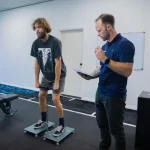
Where appropriate, Coastline uses VALD Technology, including ForceDecks and DynaMo Plus, as part of our assessment process.
These tools can provide objective information about areas of physical capacity.
That data can sit alongside other information, including:
The worker’s goals
Exercise performance
Work demands
Current tolerance
Clinical assessment
Technology doesn’t replace the person in front of us.
It gives us another piece of information when making exercise decisions.
Who Can Be Involved in a Return-to-Work Program?
Workplace rehabilitation can involve several people.
Depending on the situation, this may include the worker, treating practitioners, employer, insurer, rehabilitation provider and other relevant professionals.
The Exercise Physiologist’s role is focused on exercise and physical capacity.
Clear communication can help keep the exercise program connected to the broader rehabilitation and return-to-work plan.
Exercise Physiology for Tradies and Manual Workers
Physical jobs deserve physical preparation.
Tradies and manual workers may need to repeatedly:
Lift from the ground
Carry equipment
Push and pull
Climb
Work overhead
Kneel or squat
Stay physically active for long periods
A few isolated exercises may not reflect all of those demands.
A structured workplace injury rehabilitation program can progressively develop relevant strength and conditioning based on the person’s role and current capacity.
5 Fall Prevention Exercises That Can Build Strength and Balance
The right exercise and difficulty will vary between people. These examples show some of the movements that may be included in a structured program.
1. Sit to Stand
Start seated on a stable chair.
Stand up under control, then slowly sit back down.
This movement trains a task we perform throughout everyday life.
As strength develops, the exercise can be progressed by changing the chair height or adding appropriate resistance.
2. Step-Ups
Stepping onto a low platform can help train lower-body strength, balance and control.
It also has an obvious connection to stairs and kerbs.
The height and level of support can be adjusted to suit the individual.
3. Calf Raises
Stand with appropriate support nearby and slowly rise onto your toes before lowering again.
Calf strength contributes to walking, stepping and controlling the body while moving.
4. Supported Single-Leg Balance
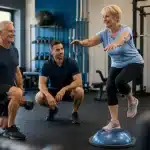
Standing on one leg challenges balance and control.
For some people, this might begin with both hands close to a stable support.
As confidence develops, the exercise can be adjusted.
The goal isn’t to perform the hardest variation possible.
The goal is to create an appropriate challenge.
5. Loaded Carries
Carrying a suitable dumbbell or kettlebell while walking can challenge grip, trunk strength and whole-body control.
It also reflects everyday tasks such as carrying shopping bags.
Resistance should match the person’s current capacity.
Fall Prevention Is More Than Standing on One Leg
If balance training only involves standing still, we can miss an important part of everyday life.
Real life moves.
We turn.
We step around objects.
We walk on different surfaces.
We carry things.
We move from sitting to standing.
A useful exercise program should consider the movements someone actually wants and needs to perform.
At Coastline Performance and Health, we look beyond a single exercise.
We want to understand what everyday life asks your body to do.
Then we can progressively train those physical qualities.
How Often Should Older Adults Work on Strength and Balance?
There isn’t one schedule that suits everybody.
Exercise frequency depends on someone’s current ability, health, training experience and goals.
More isn’t automatically better.
A structured program should provide enough challenge to encourage adaptation while allowing appropriate recovery.
For many people, consistency is the bigger priority.
A manageable program completed regularly can be more useful than an ambitious program that’s difficult to maintain.
What If Someone Is Nervous About Exercise?
It’s common for confidence around movement to change over time, particularly after time away from exercise or a change in physical capacity.
The answer doesn’t have to be avoiding movement altogether.
Exercises can be adjusted.
A squat can begin as a supported sit-to-stand.
A step-up can start with a lower platform.
A balance exercise can begin with stable support nearby.
Strength training can begin with resistance appropriate for the person’s current ability.
Then, as capacity develops, the exercise can progress.
How Can an Exercise Physiologist Help?
An Accredited Exercise Physiologist can assess someone’s current physical capacity and design exercise around their individual needs.
This may include looking at areas such as:
Lower-body strength
Balance
Movement confidence
Walking capacity
Everyday physical tasks
Exercise history
Current health considerations
Rather than handing everyone the same list of exercises, the program can be adjusted to the person.
At Coastline, our Exercise Physiologists combine clinical exercise knowledge with strength and conditioning principles.
We want exercise to prepare people for life outside the clinic.
Measuring Strength and Balance With VALD Technology
Sometimes what we see doesn’t tell us the whole story.
That’s why Coastline also uses VALD Technology, including ForceDecks and DynaMo Plus, where appropriate.
Objective testing can provide additional information about someone’s physical capacity.
For example, ForceDecks can measure aspects of force production during selected movements.
This information can form one part of an assessment alongside the person’s goals, history and how they move.
Testing isn’t about passing or failing.
It’s about gathering useful information so exercise can be planned and reviewed with greater context.
What Does a Fall Prevention Exercise Program Look Like?
A program doesn’t need dozens of exercises.
Depending on the individual, a session might include:
A sit-to-stand or squat variation
A step-up or stepping exercise
A pulling or pushing movement
A calf or lower-leg exercise
A balance task
A carrying or walking exercise
The exercises can then be progressively adjusted as the person’s capacity develops.
That’s an important difference between simply doing exercises and following a structured program.
There should be a reason behind what you’re doing and a plan for what comes next.
Frequently Asked Questions
What does an Exercise Physiologist do for WorkCover?
An Exercise Physiologist can assess physical capacity and prescribe structured exercise around relevant rehabilitation and work goals. The exact program depends on the worker, their current capacity and the demands of their job.
Is WorkCover Exercise Physiology just gym training?
No. Gym-based strength and conditioning may form part of the program, but exercises are selected and progressed around individual rehabilitation and work goals.
Can Exercise Physiology help prepare someone for manual work?
Exercise programs can be designed around physical qualities required for manual work, such as lifting, carrying, pushing, pulling and general conditioning.
How long does a WorkCover Exercise Physiology program take?
There isn't one timeframe that applies to everyone. Program length depends on factors such as current capacity, rehabilitation goals, work requirements and the individual WorkCove
Does WorkCover cover Exercise Physiology?
Exercise Physiology may be included in eligible WorkCover rehabilitation plans. Approval and referral requirements can vary, so these should be confirmed for the individual claim.
What's the difference between general exercise and work-specific rehabilitation?
General exercise focuses broadly on fitness and health. Work-specific rehabilitation considers the physical demands someone needs for their job and uses those demands to help guide exercise selection and progression.
Building Capacity for the Job, Not Just the Gym
A successful gym session isn’t the final destination.
For someone participating in workplace rehabilitation, the bigger goal may be getting back to carrying tools, working on their feet, climbing stairs, handling equipment or completing other meaningful work tasks.
That’s why we look beyond individual exercises.
We want to understand the person, understand the job and progressively build the physical capacity relevant to both.
If you’re looking for a WorkCover Exercise Physiologist in Newcastle, Lake Macquarie or Port Stephens, Coastline Performance and Health provides individual Exercise Physiology and workplace rehabilitation support from our Glendale and Williamtown clinics.





Contact US
Helping you rebuild strength across Lake Macquarie, Newcastle, & Port Stephens.
- 2/545 Main Rd, Glendale NSW 2285, Australia
- 02 7226 9384
- 2 Technology Pl, Williamtown NSW 2318, Australia
- +61 2 4989 5151