
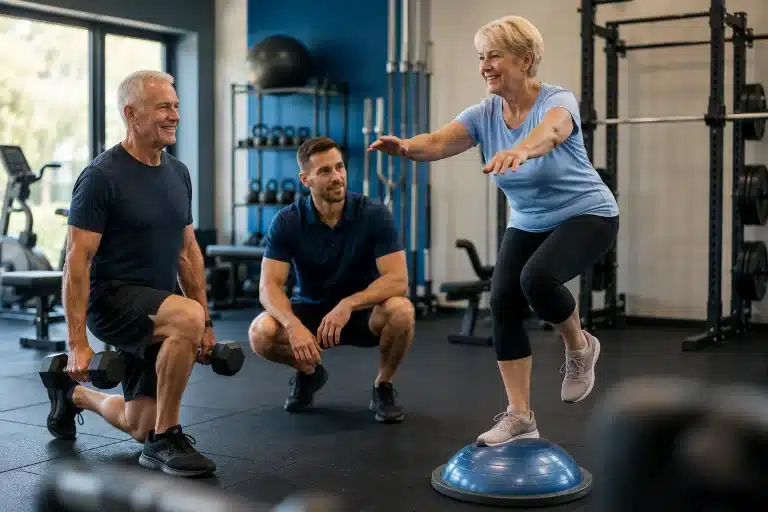
Staying steady on your feet isn’t just about practising balance.
Strength matters too.
Getting out of a chair, stepping onto a kerb, carrying groceries and walking up stairs all require your muscles to produce and control force.
That’s why effective fall prevention exercises in Newcastle can include a combination of strength, balance and everyday movement practice.
The goal isn’t to make movement smaller or more cautious.
It’s to gradually build the capacity and confidence needed for everyday life.
What Are Fall Prevention Exercises?
Fall prevention exercises are activities designed to develop physical qualities involved in staying steady and moving confidently.
A program may include:
Lower-body strength exercises
Balance activities
Walking and stepping tasks
Coordination exercises
Sit-to-stand movements
Carrying exercises
Appropriate resistance training
There isn’t one exercise that suits every older adult.
Someone’s current strength, mobility, health, confidence and goals should help guide where they start.
Why Strength Matters for Balance
Balance often gets most of the attention when we talk about falls.
But imagine losing your balance slightly while stepping off a kerb.
Your legs need enough strength to quickly control your body.
Or think about standing up from a low chair.
Your legs and hips need to produce enough force to lift your body.
Strength gives your body more physical capacity to work with.
That’s why strength training for older adults can form an important part of a broader exercise program.
5 Fall Prevention Exercises That Can Build Strength and Balance
The right exercise and difficulty will vary between people. These examples show some of the movements that may be included in a structured program.
1. Sit to Stand
Start seated on a stable chair.
Stand up under control, then slowly sit back down.
This movement trains a task we perform throughout everyday life.
As strength develops, the exercise can be progressed by changing the chair height or adding appropriate resistance.
2. Step-Ups
Stepping onto a low platform can help train lower-body strength, balance and control.
It also has an obvious connection to stairs and kerbs.
The height and level of support can be adjusted to suit the individual.
3. Calf Raises
Stand with appropriate support nearby and slowly rise onto your toes before lowering again.
Calf strength contributes to walking, stepping and controlling the body while moving.
4. Supported Single-Leg Balance
Standing on one leg challenges balance and control.
For some people, this might begin with both hands close to a stable support.
As confidence develops, the exercise can be adjusted.
The goal isn’t to perform the hardest variation possible.
The goal is to create an appropriate challenge.
5. Loaded Carries
Carrying a suitable dumbbell or kettlebell while walking can challenge grip, trunk strength and whole-body control.
It also reflects everyday tasks such as carrying shopping bags.
Resistance should match the person’s current capacity.
Fall Prevention Is More Than Standing on One Leg
If balance training only involves standing still, we can miss an important part of everyday life.
Real life moves.
We turn.
We step around objects.
We walk on different surfaces.
We carry things.
We move from sitting to standing.
A useful exercise program should consider the movements someone actually wants and needs to perform.
At Coastline Performance and Health, we look beyond a single exercise.
We want to understand what everyday life asks your body to do.
Then we can progressively train those physical qualities.
How Often Should Older Adults Work on Strength and Balance?
There isn’t one schedule that suits everybody.
Exercise frequency depends on someone’s current ability, health, training experience and goals.
More isn’t automatically better.
A structured program should provide enough challenge to encourage adaptation while allowing appropriate recovery.
For many people, consistency is the bigger priority.
A manageable program completed regularly can be more useful than an ambitious program that’s difficult to maintain.
What If Someone Is Nervous About Exercise?
It’s common for confidence around movement to change over time, particularly after time away from exercise or a change in physical capacity.
The answer doesn’t have to be avoiding movement altogether.
Exercises can be adjusted.
A squat can begin as a supported sit-to-stand.
A step-up can start with a lower platform.
A balance exercise can begin with stable support nearby.
Strength training can begin with resistance appropriate for the person’s current ability.
Then, as capacity develops, the exercise can progress.
How Can an Exercise Physiologist Help?
An Accredited Exercise Physiologist can assess someone’s current physical capacity and design exercise around their individual needs.
This may include looking at areas such as:
Lower-body strength
Balance
Movement confidence
Walking capacity
Everyday physical tasks
Exercise history
Current health considerations
Rather than handing everyone the same list of exercises, the program can be adjusted to the person.
At Coastline, our Exercise Physiologists combine clinical exercise knowledge with strength and conditioning principles.
We want exercise to prepare people for life outside the clinic.
Measuring Strength and Balance With VALD Technology
Sometimes what we see doesn’t tell us the whole story.
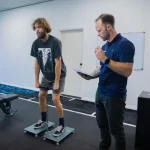
That’s why Coastline also uses VALD Technology, including ForceDecks and DynaMo Plus, where appropriate.
Objective testing can provide additional information about someone’s physical capacity.
For example, ForceDecks can measure aspects of force production during selected movements.
This information can form one part of an assessment alongside the person’s goals, history and how they move.
Testing isn’t about passing or failing.
It’s about gathering useful information so exercise can be planned and reviewed with greater context.
What Does a Fall Prevention Exercise Program Look Like?
A program doesn’t need dozens of exercises.
Depending on the individual, a session might include:
A sit-to-stand or squat variation
A step-up or stepping exercise
A pulling or pushing movement
A calf or lower-leg exercise
A balance task
A carrying or walking exercise
The exercises can then be progressively adjusted as the person’s capacity develops.
That’s an important difference between simply doing exercises and following a structured program.
There should be a reason behind what you’re doing and a plan for what comes next.
Frequently Asked Questions
What exercises can help older adults work on balance?
Balance programs may include stepping activities, supported single-leg exercises, sit-to-stands and other movements that challenge control. Strength exercises can also be included because staying steady requires physical capacity as well as balance.
Is strength training appropriate for older adults?
Strength training can be adapted to different ages and abilities. The exercises, resistance and progression should reflect the individual's current capacity, health and experience.
Do I need gym experience to start?
No. Exercises can start at a level that matches someone's current ability. Learning how to perform movements confidently is part of the process.
Is walking enough for balance and strength?
Walking is useful physical activity, but it doesn't challenge strength in the same way as progressive resistance exercise. A broader program may include walking alongside strength and balance exercises.
What if I've never lifted weights before?
You don't need previous weight training experience. Resistance can begin at an appropriate level and gradually progress as technique, capacity and confidence develop.
Can an Exercise Physiologist assess balance and strength?
Exercise Physiologists can assess different aspects of physical capacity and use that information when planning exercise. The exact assessment will depend on the individual and their goals.
Build Strength for Everyday Life
Fall prevention doesn’t need to mean becoming more cautious with everything you do.
A different approach is to build more capacity.
More strength for getting out of a chair.
More control when stepping onto a kerb.
More confidence when carrying shopping.
More practice doing the movements everyday life requires.
At Coastline Performance and Health, our Exercise Physiologists and Strength Coaches provide structured exercise for older adults based on individual capacity and goals.
If you’re looking for fall prevention exercises in Newcastle, Lake Macquarie or Port Stephens, an initial Exercise Physiology assessment can help establish an appropriate starting point.



Contact US
Helping you rebuild strength across Lake Macquarie, Newcastle, & Port Stephens.
- 2/545 Main Rd, Glendale NSW 2285, Australia
- 02 7226 9384
- 2 Technology Pl, Williamtown NSW 2318, Australia
- +61 2 4989 5151